
Foxconn Accelerates into Global EV Market with Two U.S.-Bound Models, Eyes Competition with Nissan

Foxconn Accelerates into Global EV Market with Two U.S.-Bound Models, Eyes Competition with Nissan
As part of a global push into the automobile industry, Foxconn, the company that makes iPhones, intends to produce two electric car models for the US market. At a press conference held here on April 9, Jun Seki, a senior executive at Foxconn and a former Nissan employee, presented the company’s capabilities as an EV contract manufacturer to international automakers. He also described Foxconn’s ambitions for a range of six battery-powered light cars and buses. Amid circulating rumors that it may collaborate with Nissan Motor Co., Honda Motor Co., Mitsubishi Motors Corp., or possibly a combination of all three, the Taiwanese electronics behemoth is making a bold foray into the global auto sector to develop next-generation software-defined electric vehicles.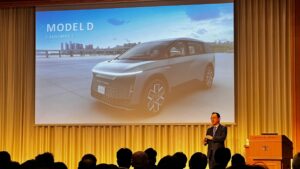
On stage before a packed crowd, Seki said his company has the toolbox to design and assemble a full range of EVs. They will initially be built in Taiwan and shipped around the world, though Foxconn can also produce locally in different regions depending on customer needs, he said. “It is right to make them in the market where they are sold. But it is inefficient without a certain number of units, so we are making them in Taiwan now as a transitional measure,” he said.
Vehicles for the U.S., he added, are expected to eventually be made in America. On the light vehicle side, Seki presented the Model C midsize crossover, Model B compact sporty crossover, Model D people-mover van, Model E sporty midsize sedan and Model A compact van. In buses, he highlighted plans for a Model T large bus and Model U minibus. Foxconn plans to export the Model C to the U.S. for customers there to trial in the fourth quarter of 2025, Seki said. The Model D crossover-styled MPV is slated for the U.S. in 2027, he added.
Foxconn details global rollout of full EV lineup
Hon Hai Precision Industry Co., as the company is officially called, is planning to make the Model B for a Japanese automaker to introduce in Australia in the first half of 2026, Seki said. Japanese media earlier reported the customer as Mitsubishi Motors Corp. The Model B will be introduced to the Taiwan market in the second half of the year. The Model C that is planned for America is Foxconn’s first mass-production EV. It entered production in December 2023 for the Taiwan market, where it is sold as the Luxgen N7. Key specs include a 172-kilowatt motor in the rear-wheel-drive version, and double that power for the all-wheel-drive setup. It has 460 hp and runs 0 to 62 mph in 3.8 seconds.
The Model C comes with either a 58-kilowatt-hour battery or 83 kWh pack. Depending on the battery, Foxconn puts its range at 310 miles or 435 miles under the New European Driving Cycle, which is considered more lenient than the EPA ratings. A rendering of the North America version of the Model C, shown by Seki, depicted a sleek crossover with creased, wavy side paneling and an undercut front fascia. The larger Model D, also planned for the U.S., gets a long wheel base with a raked rear window and a short front hood that exudes elongated crossover proportions. That vehicle will sport air suspension, Seki said.
Finally, a pint-sized Model A is being positioned for duty as an urban runabout, taxi or delivery vehicle. It is expected to be introduced to Japan in the first quarter of 2027. The Model A will be launched in southeast Asia after that, Seki said.
Foxconn still chasing Nissan
News of a Foxconn tie-up with Mitsubishi comes amid mounting reports that it is interested in partnering with Nissan and possibly even a combination of Nissan, Honda and others. Chairman Young Liu told reporters in February that his company is interested in partnering with Nissan but not acquiring the company. Later that month, after Nissan and Honda ended negotiations about a possible merger of the two automakers, Foxconn reportedly proposed a four-way alliance, teaming the Taiwanese tech firm to Nissan, Honda and Mitsubishi.
In Tokyo, Seki reiterated Foxconn’s interest in partnering with Japanese carmakers, including Nissan, and said his company is working with Mitsubishi, though he declined to give details. Analysts often champion a Foxconn as a top candidate for automotive alliances, partly because Seki is a former Nissan COO, and partly because Foxconn brings electronics knowhow.
Seki touted Foxconn as a low-cost, high-quality manufacturer steeped in cutting-edge technologies with an obsession with customer confidentiality. He cited Foxconn’s expertise as the world’s biggest assembler of iPhones in saying EVs are essentially smartphones on wheels. He praised Japanese automakers as ideal partners because of their reputation for quality.
“Japanese carmakers are careful planners, and we understand that but are also very fast,” Seki said. “We can do things faster while understanding Japanese prudence.” In 2023, Foxconn hired Seki as its chief strategy officer for EVs. In 2019, Seki was tapped as a member of the original leadership team of former Nissan CEO Makoto Uchida. But Seki left Nissan just weeks into the job to become CEO of Nidec Corp., a Japanese producer of electric motors.
Seki said Foxconn’s automotive endeavor will follow its approach to electronics. It will be a business-to-business model, not a business-to-consumer model. Foxconn, he said, won’t directly compete with automakers.
#FoxconnEV#ElectricVehicles#EVRevolution#GlobalEVMarket#FutureOfMobility